StemBond — full investor film transcript v065 · 14 minutes 29.760 seconds
[00:00] StemBond Technologies StemBond Technologies. Better medicines need better cell culture. We're a biotech tools company enabling the development of new medicines and advanced therapies.
[00:11] The gap between longer life and effective treatment Around the world, people are living longer. But years in good health haven’t kept pace. Many patients still lack effective treatments. And the time, cost and risk of developing new medicines limit what reaches them.
[00:25] Before a clinical trial That challenge starts long before a clinical trial. Researchers need to understand disease, test potential medicines and develop advanced therapies. Much of that work depends on experiments with living cells.
[00:39] Cells need a better place to grow In living tissue, surrounding proteins form a supporting network. Cells interact with it as they grow and do their work. Researchers recreate relevant parts of that environment inside a laboratory plate's wells. StemBond tackles the physical foundation beneath those cells.
[00:58] A product built for a bigger opportunity Our product is SENCE™: Cambridge hydrogel technology, supplied in familiar laboratory plates. It is already shipped and in evaluation. The opportunity is commercial scale in a global plate market worth about two point four billion dollars. Investment now builds the evidence and sales capacity to turn early use into repeat business.
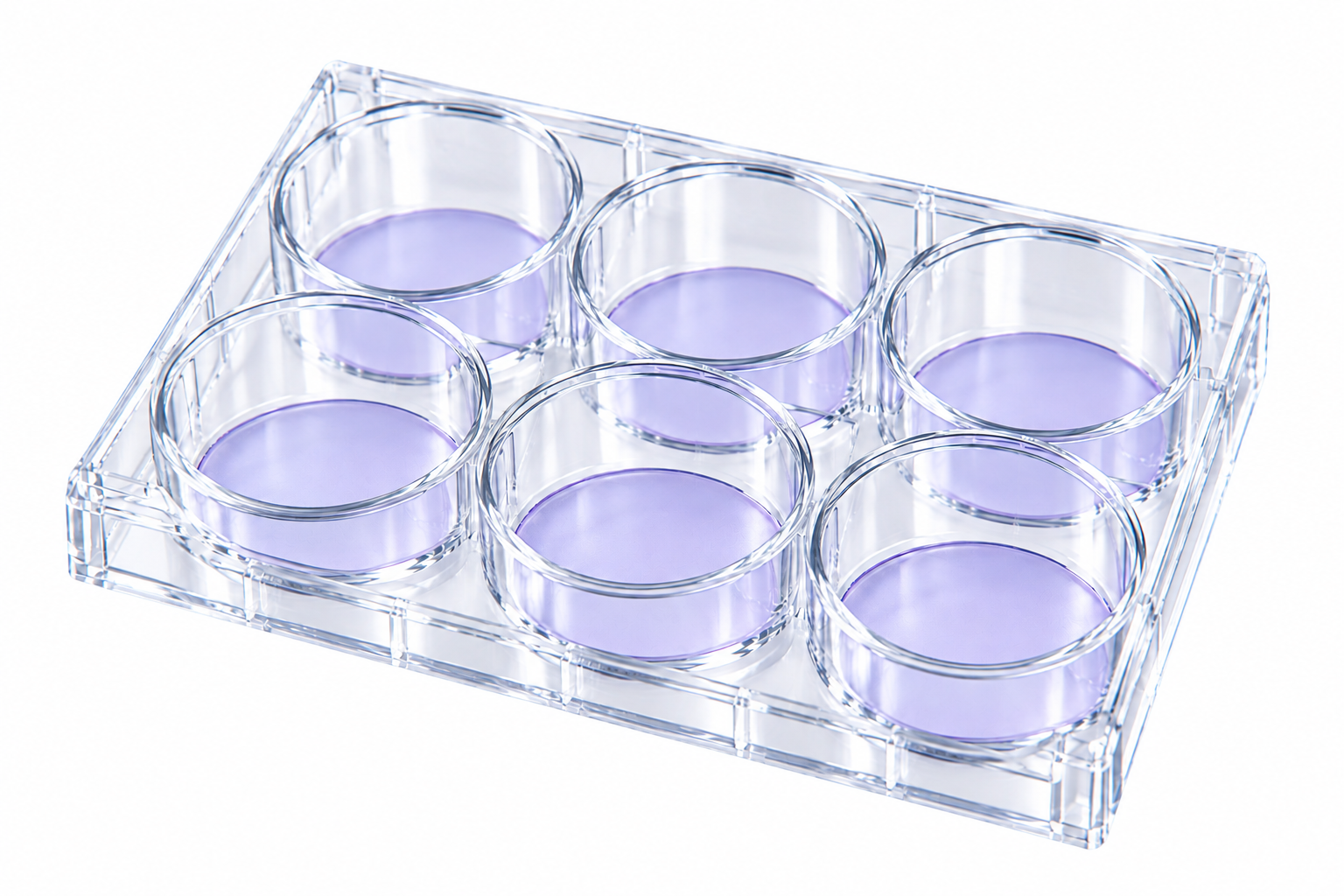
[01:22] Where the experiment happens Start with a laboratory plate filled with small wells. Living cells receive nutrients and suitable conditions to grow. A researcher changes a condition, runs the experiment, then measures the response. That is cell culture.
[01:38] Four jobs for living cells These experiments help researchers understand disease and find possible targets. They help test drugs and develop cell and gene therapies. Sometimes, the cells grown in the laboratory become part of the medicine itself. But growing cells in unrealistic laboratory environments can send researchers in the wrong direction. We can miss important targets and chase false positives. Without reliable human models, we remain reliant on animals. The wrong conditions can also make it harder to grow enough cells with the qualities a therapy needs.
[02:15] The hydrogel is already in the plate SENCE™ lets researchers choose the physical foundation for their cells. Its engineered hydrogel layer comes already coated onto the bottom of the wells, ready to use. Our initial range covers six, twelve, twenty-four and ninety-six well plates, in four firmness options, at two hundred pounds per plate. Researchers order a firmness relevant to their question, then add their chosen protein coating, cells and culture medium. The gel is supplied animal free.
[02:47] Every surface brings a tradeoff Why does that choice matter? Consider the surfaces researchers use today. Each brings a different compromise.
[02:55] Plastic is simple, but very stiff Standard laboratory plastic is clear, inexpensive and easy to use. But it is vastly stiffer than most human tissues.
[03:04] A rich mixture can be hard to untangle Animal derived matrices such as Matrigel provide a rich mixture. But they contain many components, vary between batches and combine physical and biological signals, making the result harder to interpret.
[03:19] Making a gel takes work Researchers can make adjustable gels, such as polyacrylamide. But making the gel, preparing it to hold proteins, adding the coating and checking the result takes specialist time and skill. The Cambridge hydrogel behind SENCE™ was engineered for stable protein attachment, controlled independently of firmness.
[03:40] Specify it. Buy it. Use it again. SENCE™ puts that Cambridge technology into a plate laboratories can specify, buy and reorder. We hold an exclusive worldwide licence to the core hydrogel patent family. Researchers can choose physical conditions closer to the tissue they want to study, so the experiment becomes a more useful model of cells in the body. Researchers keep control of the biology they add.
[04:06] Cells respond to their surroundings Cells respond to their surroundings, including proteins and materials that respond when a cell pushes or pulls.
[04:14] The physical foundation matters An attached cell reaches out, grips proteins and pulls. The material pushes back or gives way. That exchange can change signals inside the cell, affecting how it attaches, grows and behaves. The physical foundation is part of the model. What a cell feels can change what the researcher measures.
[04:38] Test the result that matters For a customer, adoption begins with one practical question: can SENCE™ improve a result that matters to our programme?
[04:46] An experiment with a useful answer Picture a team developing a treatment made from living cells. Some must calm an unwanted immune attack, and keep that ability as they grow. To test SENCE™, the team keeps the same starting cells, coating, liquid and measurement method, then compares its existing surface with selected SENCE™ conditions. They agree what improvement would count.
[05:10] A useful result earns more work If a condition produces a valuable result, the team repeats it. A condition that keeps earning its place can extend into more batches, projects or sites.
[05:21] Test. Measure. Earn the repeat. That makes customer evaluation our route to market: a paid test, agreed measures, and a clear decision. Successful work needs fresh plates, turning recurring laboratory use into repeat demand.
[05:36] The engine has already begun SENCE™ has sold and shipped into customer work, including in the United States. Nine organisations are engaged at different stages, from evaluation to ordering and repeat use.
[05:48] The environment could override age Let's look at some of the discoveries already enabled by SENCE™. One is a discovery about the ageing brain. As we age, the brain's ability to repair its insulation declines. That matters in neurological disease, where losing myelin can disrupt movement, memory and independence. Cambridge researchers wanted to know why the cells responsible for repair stopped doing their job. Were older cells worn out, or were their surroundings holding them back? To answer that, they needed to separate the effect of firmness from the proteins a cell attaches to. The hydrogel technology behind SENCE™ made that comparison possible. They varied gel firmness while controlling protein attachment. On firmer gels, aged rat brain repair cells showed reduced division and maturation. On soft gels, those functions returned. Their gene activity shifted towards a younger state. The environment had overridden the effects of physiological age. It had effectively rejuvenated these cells. Published in Nature, the discovery changed what researchers could ask about brain ageing. The long-term possibility is profound: finding ways to restore repair, protect nerve function, and help people retain the abilities that make life their own.
[07:15] Six studies. Six biological questions. That hydrogel technology has supported six studies, spanning brain repair, pluripotent stem cells, liver development, developmental signals, regeneration and blood stem cells. Different biological systems, each asking how the environment changes the answer.
[07:35] Help the immune system protect the body Now return to the challenge of growing cells that can calm an unwanted immune attack. In autoimmune disease, immune cells attack healthy tissue. Regulatory T cells, or Tregs, help restrain that activity. Researchers want to use them as medicines. The challenge is growing enough cells while keeping their calming function. More cells must still do what the treatment needs.
[08:01] A clue towards more useful cells In our laboratory studies, mixed T cells on SENCE™ showed a stronger gene signal linked to immune regulation than on coated plastic, after seven days. If that signal reflects lasting function, SENCE™ could help customers grow useful cells for future Treg medicines: calming autoimmune attacks and protecting healthy tissue.
[08:25] A defined starting point The FDA is advancing validated alternatives to animal testing, including human cell models. That gives this work a timely context. SENCE™ supplies a defined, animal free starting surface. The laboratory chooses the biology it adds, and the test that matters.
[08:46] A large market. A specific first 400. We estimate laboratories use around two hundred and forty million multiwell plates each year. Five to nine thousand organisations could be relevant to SENCE™. We have mapped the first four hundred to prioritise and approach, focused on experiments where the physical environment matters.
[09:05] A useful result can travel An application note shows another team the question, conditions and result. It gives them a reason to evaluate SENCE™ in their own work. The sales capacity this investment builds will turn that interest into agreed tests, with distributors and partners extending our reach as those routes develop. Useful evidence will travel.
[09:27] The larger enterprise-value potential Our long term ambition is three to six per cent of the cell culture plate market's revenue. The plan illustrates enterprise values ranging from hundreds of millions to over a billion US dollars across those scenarios. These are valuation sensitivities, not forecasts. The question is how we build towards that scale.
[09:49] Build the first stage Reaching that scale starts with a lean, focused twenty-four-month commercial build. The aim is to establish repeat customer demand, a sales process we can scale, and qualified manufacturing through specialist partners. That reduces the risks of expansion and prepares the business for much faster growth. We have modelled two-year commercial plans for investment of four hundred thousand pounds, seven hundred thousand pounds, and two million pounds. The cases target around sixteen to forty-nine active accounts, with annual product sales running at roughly four hundred and sixty thousand to one point eight million pounds by month twenty-four. More funding lets us run more evaluations and build the team and supply capacity in parallel. Within those two-year plans, our current round is extending to seven hundred thousand pounds and beyond.
[10:44] Scale supply without a large factory We've already identified credible pathways to manufacturing scale. Specialist partners can supply cultureware, coating and assembly. StemBond keeps the specification, biological validation, quality control, batch release and customer relationship. Supply can grow without building a large factory.
[11:07] More use. More valuable applications. Growth has two directions: more plates as customers repeat successful work, and more value through specialised applications, new formats and licences.
[11:18] The actual conservative case Looking further ahead, our conservative long term model follows the more highly funded two million pound expansion case. That funding need not all be raised in the current round: additional capital could be sought later as needed, with the pace of expansion depending on the funds secured. The model illustrates enterprise value of sixty to one hundred and forty million pounds, based on about twenty million pounds in annual sales, or roughly one hundred and four thousand plate equivalents a year. Those figures assume a twenty four month commercial build followed by five scale years, with follow-on funding.
[11:58] A product with room to expand That creates strategic choice: continued independent growth, wider partnerships, or acquisition by a global life science company.
[12:09] Backed by people who know the sector Cambridge Enterprise, First Spark Ventures, Start Codon, and Abcam founder Jonathan Milner through Meltwind have backed StemBond. One and a half million pounds of pre seed funding helped build the product.
[12:23] What this investment builds Four hundred thousand pounds is committed, subject to closing and receipt. The next capital builds the commercial engine: sales and applications capacity, qualified production and a commercial channel pilot. An accelerating library of application notes and evidence supports that work.
[12:43] Commercial execution, backed by Cambridge science Founder and CEO Andrew Hodgson has a Cambridge PhD in physics, alongside master's degrees in astrophysics and nanotechnology enterprise. He is an expert in designing and fabricating advanced technology for cell culture, and leads the company and its scientific selling. Our chair, Robert Preti, PhD, has already built a business around helping cell therapies reach patients. Bob co-founded PCT in nineteen ninety-nine. By twenty sixteen, PCT was generating about thirty-five million dollars in annual revenue. Hitachi Chemical acquired the business in twenty seventeen. Bob then took responsibility for Hitachi Chemical's global regenerative medicine operations. For StemBond, that experience matters. He understands how researchers become commercial customers, what scalable manufacturing demands, and how to build a life science business that a global company wants to acquire. Fractional CFO Matt Cobbett built ImmunoScape's US operations and helped raise its twenty-five million dollar Series B. Technology co-inventor Kevin Chalut was Professor of Mechanobiology at the Cambridge Stem Cell Institute, bringing expertise in stem cell biology and mechanobiology.
[14:02] A defining surface for advanced cell culture Our ambition is a defining surface for advanced cell culture: a recurring product, scalable supply and valuable new applications.
[14:13] Better medicines need better cell culture Discoveries start with the right conditions. Help us enable the discoveries that tomorrow’s medicines depend on.